
And so…I made it to 10 years!
My original post was an account, as best as I could write, of my cardiac arrest and resuscitation in 2017. I have written a few other articles over the years, and I would like to think that by this point I could give some erudite insight into surviving an arrest, navigating the post-survival chaos and then rebuilding a new life with whatever limitations the arrest has placed on you; however, I’m not sure that I can.
What I can give you is some insight into my arrest, my survival and my new life with the hope that it provides some inspiration or amusement for people struggling at whatever stage they are at post-survival.
For those that don’t know me, in a previous life (quite literally) I was a City tech-bro, balding, ageing but with no real risk-factors (apart from being overweight). I went to work one day (7 July 2016 to be precise) went for a swim at lunch-time and suffered a cardiac-arrest after I had got out of the pool. I had a seven-minute downtime, CPR, one shock, and was breathing, conscious, talking and very much alive by the time that London Ambulance Service personnel arrived. I was shipped off to Bart’s Hospital where I had a stent inserted into a coronary artery and then, pretty much, spent a week twiddling my thumbs before being discharged. I appeared to suffer no neurological deficit beyond losing a few memories, and I returned to “normal life”.
I wouldn’t say that my arrest was any more or less dramatic or interesting than anyone else’s apart from the fact that it was captured on CCTV, so I’m one of the few people in the world who’s watched himself arrest and be resuscitated. Let me tell you that I found watching the footage disturbing. Disturbing how fat I looked in a pair of swimming trunks (fortunately not Speedos).
Life pretty much returned to normal for me afterwards, albeit with a daily ingestion of medication (some days I feel that I take more pills than an Olympic sprinter). I went back to the same job, the same office, the same daily grind. At the time I wanted to “get back to normal” which, for me, meant going back to my previous life, but, now, in retrospect, I wish that I had been more bold, more “inspired” and jacked it all in and done something slightly more interesting. But, then, that’s the benefit of hindsight.
Although my arrest was thought to be due to an MI (heart attack), it was subsequently discovered that I have an enlarged heart and it is now thought that I have dual cardiomyopathy: both dilated and arrhythmogenic. This is likely to be inherited, and there is some irony that all my hard work keeping fit and healthy probably was of no use! So, basically, I missed out on boozing and eating chips for no good reason.
Possibly because of the dilated cardiomyopathy I have suffered recurrent atrial arrhythmias (Atrial Fibrillation and Atrial Flutter) and I have lost count of the number of DC Cardioversions (defib shock to the heart in hospital) that I have had to correct this. In fact, they should name one of the Cath Labs at Bart’s after me, seeing that I’ve been in it so many times. I’ve also had three catheter ablations (not fun) to try to correct these recurrent arrhythmias and, touch wood, I am in a normal rhythm (and long may it continue), but I have to resign myself to the fact that the AF will return at some point and it is unlikely that I would have another ablation.
I have also suffered with a conduction issue in my heart called “3rd degree block” which necessitated the insertion of a pacemaker. Given my history, it was decided to make this a dual pacemaker/ICD (defibrillator), which I had fitted in 2021 during lockdown. NB I wrote an account of this for anyone facing the same.
Personally, I was of the opinion that the pacemaker was needed, but I wasn’t so happy about the ICD as I felt that my arrest was understood to be caused by an MI so the ICD was unnecessary and it placed restrictions on driving (I also couldn’t be an aircraft pilot or helicopter pilot, first-world problems I suppose).
And unnecessary…well it was for the first five years until… April 2025, when I went for a short run (2 miles) and “felt a bit funny” halfway round. Turns out that I had Ventricular Tachycardia (VT – a very dangerous rhythm), which my ICD managed to correct; interestingly, it paced me out of VT and didn’t need to shock me. I didn’t realise what had happened but “felt better” so sprinted home. I do like to live dangerously. However, Bart’s Rang me and I had to surrender my driving licence for six months, so I embraced the bus and Uber.
Ok, so that’s my cardiac story.
So what did I do next….
Well, “Life After Cardiac Arrest” was strange, as I think it is for all of us. I was a little astounded by what had happened, but also the fact that I appeared to suffer no neurological effects from hypoxia when my heart wasn’t pumping. I did and do feel different to the person I was before my arrest, but I can’t put it into words why; I just know that I am not the man I was on the morning of 7 July 2016.
I discovered the Sudden Cardiac Arrest UK Facebook group sometime in late 2016 as I recognised that I needed some perspective from fellow survivors, and I am indebted to Paul Swindell for setting up the group. I embraced the group and discussions, and I felt that the other members really helped me, especially at the meetups.
As a cliché, I decided to “give something back” so I trained as an Ambulance Service Community First Responder and duly set about helping my local community.
In 2022 I retired from full-time “tech bro” work. I then did some additional qualifications, learnt to drive on blue lights (the exciting bit), and joined the ambulance service part-time as an Emergency Care Assistant (a lower clinical grade than a full Paramedic). I have worked on front-line ambulances for the last four years. The work is tough, and there can be long days in the ambulance. Normally, the paramedic and I take it in turns to attend to the patient: one of us attends, one of us drives (unless it’s something outside of my comfort zone). The job is both rewarding and frustrating; I would estimate that more than 50% of the 999 calls do not need an ambulance and the rest? Well, about 45% need an ambulance but are not clinically “exciting” jobs, and the last 5% is where “BBC Ambulance” get their footage! I have attended a number of road traffic collisions, a number of cardiac arrests, I’ve performed CPR, I’ve shocked with a defibrillator (makes a change from being shocked by one), and I have resuscitated a three (NB this is a team effort, not just me), unfortunately, I’ve attended to patients that didn’t survive. I have performed a resuscitation on a train as a “bystander” when no one else would pitch in, and the person survived. I got a £5 meal voucher from GWR Trains as a thank-you so not all bad. With the ones that I’ve resuscitated, I like to think that I’ve achieved payback.
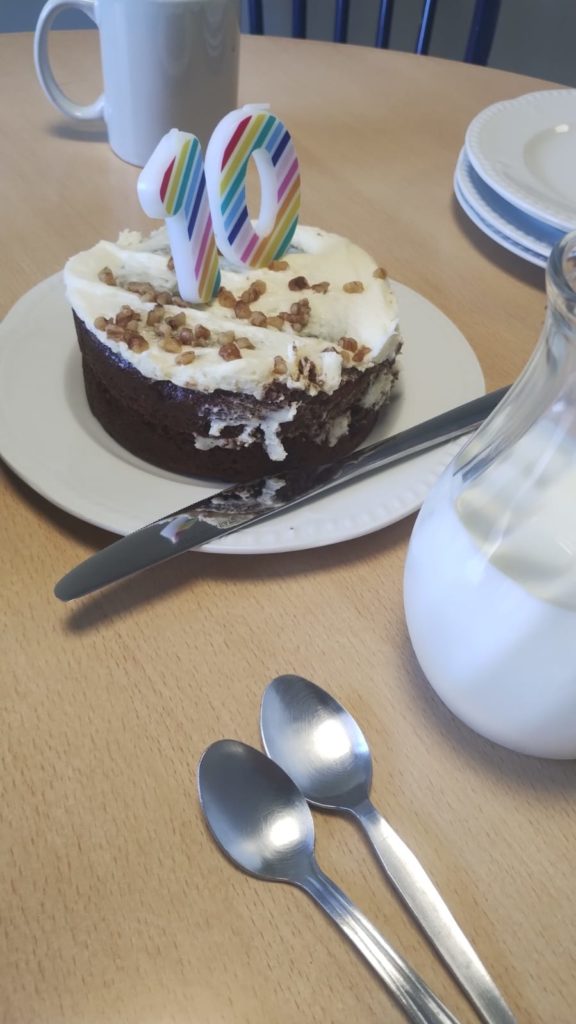
And so ten years on….. I’m 20 Kg lighter than in 2016 (intermittent fasting, not liposuction), I am semi-retired, I work in healthcare, I still swim, I do music (guitar/singing), I’ve given CPR and defibrillator shocks as well as receiving them, I’ve ensured that three people are walking around who otherwise would be ashes in the urn on the mantlepiece. And none of this would have occurred if I hadn’t had a cardiac arrest in 2016; it changed me and my life for the better, however strange that sounds. I’m definitely now living my best life
And my tenth anniversary?
Well, I’m swimming in the same pool as 2016, I’m going to lie on the same lounger by the pool where I arrested (as I said, I like to live dangerously) and I’m going to visit Bart’s Hospital (hopefully, this time not in an ambulance). I don’t drink any more (because of atrial arrhythmia), so I will metaphorically raise a glass after the swim. Then I’ll get back to living my best life.
Ten years! Here’s to the next ten.

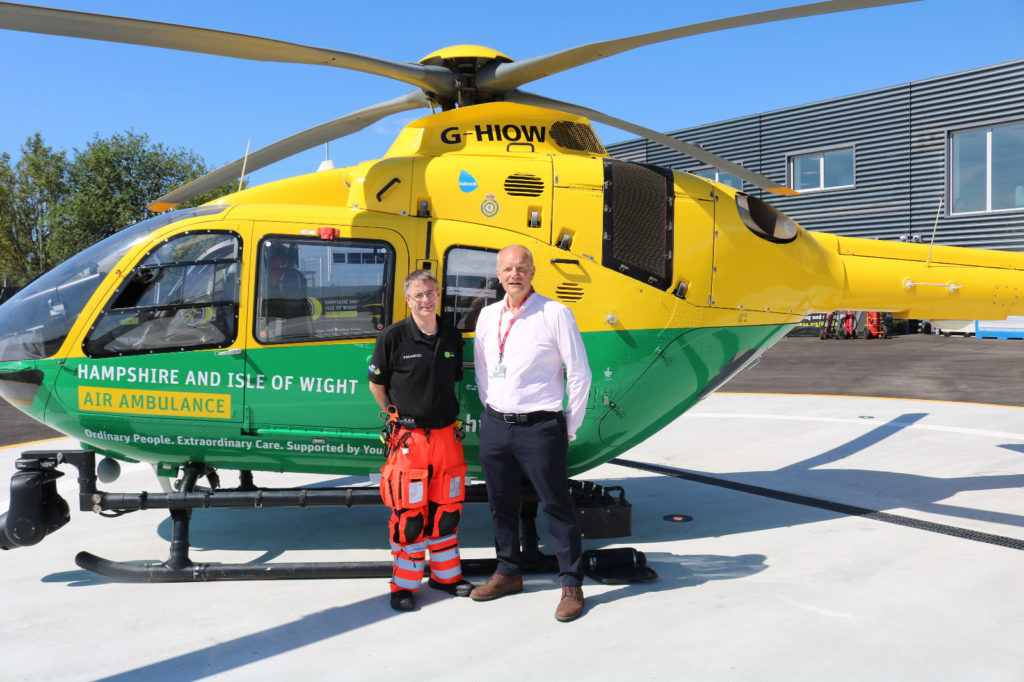
David Jeffery’s cardiac arrest was captured on CCTV. Since his arrest, he has become a Community First Responder, turning his own experience of sudden cardiac arrest into a commitment to save others.