
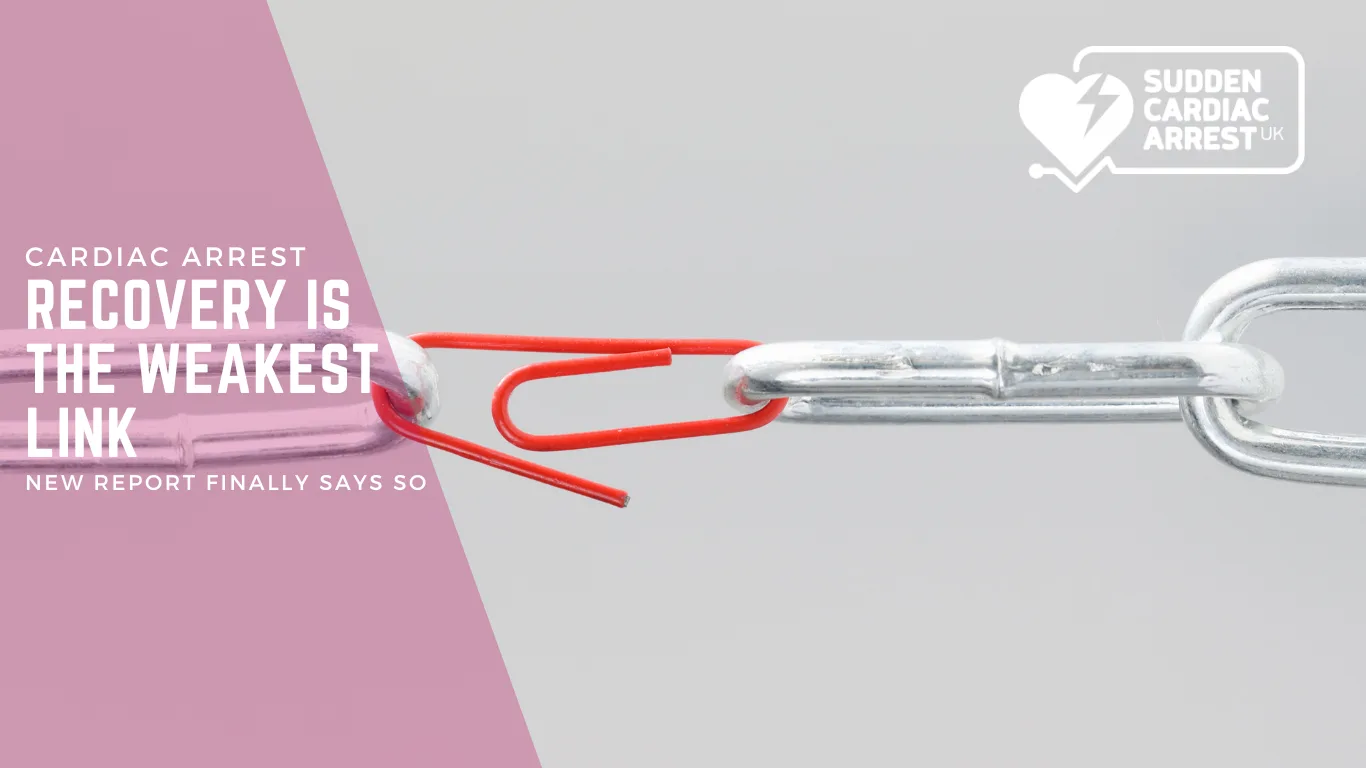
Survive a cardiac arrest in the UK, and you will be treated as a medical miracle. Then, often, you will be sent home and forgotten.
That is the uncomfortable truth at the heart of a landmark new report published this month by the Resuscitation Council UK. The Weakest Link: Recovery After Cardiac Arrest makes a compelling case, through real human stories, that recovery after cardiac arrest remains the most neglected stage of the entire chain of survival. At Sudden Cardiac Arrest UK, this report says aloud what our members have been telling us for a decade.
What the Report Found About Cardiac Arrest Recovery
According to the report, every year approximately 40,000 out-of-hospital cardiac arrests occur in the UK, where resuscitation is attempted. Emergency care, in many hospitals, is excellent. Yet fewer than one in ten people survive to hospital discharge, and for those who do, the journey is only beginning.
Cognitive impairment affects around half of all survivors. Physical limitations persist in roughly four in ten. Fatigue, anxiety, depression, and PTSD are common. And yet, once the hospital doors close, many survivors encounter silence where they expected support.
MacLean MacLeod, one of our SCA UK members and a fit, active member of a coastal rowing club in Moray, received exemplary care after his cardiac arrest in April 2022. Three stents, three weeks in hospital, a life saved by his teammates’ quick thinking. And then? “I felt abandoned, like I was left to figure out recovery alone.” MacLean is not alone in feeling that way. He is, in fact, the rule rather than the exception.
The Quality Standard That Drives Our Work
The RCUK Survivor Quality Standard, published in 2024, sets out clear expectations for assessment, rehabilitation, and follow-up from discharge through to long-term recovery, addressing physical, cognitive, psychological, and social needs for both survivors and their families. The Standard has been one of the driving forces behind what SCA UK does, and we press for its adoption at every opportunity.
The report highlights the pioneering work of Professor Keeble and the team at Essex Cardiothoracic Centre, whose specialist reviews have shown how structured follow-up meaningfully improves outcomes at six months. Professor Keeble is a trustee of SCA UK, and we are proud that his work is recognised here. Also at Essex Cardiothoracic Centre, Dr Uzma Sajjad leads the RESCQ project, which SCA UK is proud to be involved with. RESCQ is focused on supporting lay resuscitation rescuers, the people who perform CPR at some of the most distressing moments of their lives, and whose own needs are routinely overlooked. That work has just been awarded Best of the Best Abstract at the forthcoming European Resuscitation Council Congress in Milan. A thoroughly deserved recognition.
The Norfolk and Norwich University Foundation Trust ran a 17-month Quality Standard-aligned pilot clinic that worked and was then discontinued due to funding constraints. The report is right to call that out. Barts Heart Centre, by contrast, has sustained its OHCA Pathway since 2022 through genuine multidisciplinary commitment, with annual family days co-delivered with SCA UK input. This is the Quality Standard working as intended.
A Tale of Four Nations: Where Cardiac Arrest Recovery Stands Today

Writing this from the Scottish Cardiac Arrest Symposium 2026 in Edinburgh, the contrast between the four UK nations could not be sharper. Scotland is the only part of the UK with a dedicated national cardiac arrest strategy actively in motion. Wales is following with its own version. England and Northern Ireland have nothing equivalent.
Scotland has its Out-of-Hospital Cardiac Arrest Strategy 2021 to 2026. In 2025, Save a Life for Scotland Recovery was established specifically to implement the Quality Standard, and Chest, Heart and Stroke Scotland has launched a pilot advice line for bystanders and key supporters who have performed CPR or witnessed an OHCA. The energy in the room here in Edinburgh reflects that momentum.
Wales is developing its own Cardiac Arrest Survivor Quality Standards, building directly on RCUK’s framework and embedding standardised discharge information across NHS Wales. Meaningful leadership from a relatively small nation.
England has no dedicated cardiac arrest strategy. Cardiac arrest sits inside the broader NHS 10 Year Health Plan and an ageing 2017 framework. A new rapid resuscitation protocol has reduced response times in pilot areas by fifteen per cent, which is welcome. But survival rates remain at 9.5% at 30 days, and consistent follow-up remains elusive for most survivors.
Northern Ireland faces the steepest climb. There is no dedicated strategy; post-arrest care remains underdeveloped, and geographical inequalities compound the challenge outside urban centres. This is all the more striking given that Northern Ireland is the birthplace of Dr Frank Pantridge, whose invention of the portable defibrillator and the mobile coronary care unit transformed cardiac arrest survival worldwide, and whose conviction that life-saving care could be delivered before a patient reached hospital underpins everything the chain of survival represents. His legacy is remembered. It deserves to be built upon.
Why This Report Matters to SCA UK
Several of our members share their stories in the report. Ruth Harvey found her way to SCA UK after navigating severe fatigue, neurological symptoms, and PTSD largely alone. Her partner, Simon, who performed CPR and saved her life, received no professional support whatsoever. Alan Owen waited more than a year for a mental health appointment after his cardiac arrest, despite a referral being made. And Josephine Wren watched her daughter, Siobhan, survive a cardiac arrest in the United States, return home to unclear follow-up and further shocks, and navigate it all without meaningful guidance. Josephine has since channelled that experience into advocacy, contributing as a parent representative to the European Resuscitation Council’s 2025 paediatric resuscitation guidelines. That is what lived experience, properly valued, can achieve.
These are SCA UK members. Their stories are not outliers. They are the everyday reality of cardiac arrest recovery in this country.
What Needs to Happen Now
England and Northern Ireland need dedicated cardiac arrest strategies of the kind Scotland is delivering, and Wales is building. NHS commissioners must develop sustainable post-arrest recovery models, and funding must follow through on commitments.
Ruth Cadbury MP puts it plainly: “Survival is only the first step. Recovery must be supported through equitable, multidisciplinary services that reflect the complex needs of survivors and their families.”
This report gives every decision-maker the framework they need. There are no more excuses for delay.
Further Reading
Download The Weakest Link: Recovery After Cardiac Arrest and the RCUK Survivor Quality Standard at resus.org.uk. To find out more about the RESCQ project, read more about RESCQ here.
If you are a cardiac arrest survivor or co-survivor, visit our website or join our community.

After our first meet-up in February 2015, I realised I was not alone. It was the first time since my cardiac arrest the previous year that I had spoken face-to-face with someone who had experienced what I had. This was also true for my wife, who also happened to be my lifesaver. From that meet-up, the idea of SCA UK was born. Since then, we have achieved a considerable amount, primarily providing information, resources and support to others in a similar situation but also raising the profile of survivorship and the need for better post-discharge care. We are starting to get traction in this, and with the formation of the charity, I genuinely believe we have a bright future ahead and will make a significant difference in the lives of many who join our ranks.