
This is a developing story. We will update it as the Danish Football Association and Eriksen’s medical team provide more information.
Last night, playing for Denmark against Ukraine, Christian Eriksen collapsed on the pitch, and the match was abandoned. Within minutes, the early reports were already muddying the facts. So here is what we know in plain English, along with the bits the headlines keep getting wrong. We are Sudden Cardiac Arrest UK, a charity run by and for cardiac arrest survivors and their families, which is exactly why we care about getting this right.
The good news first. Eriksen was treated on the pitch, got back to his feet, and walked to the ambulance under his own power. The Danish Football Association have confirmed he is conscious and doing well under the circumstances. We do not yet know the cause, and it would be wrong to guess. But for a man who lives with an implantable cardioverter defibrillator (ICD), walking off the pitch is the kind of outcome that device is designed to make possible.
Heart attack or cardiac arrest? They are not the same thing
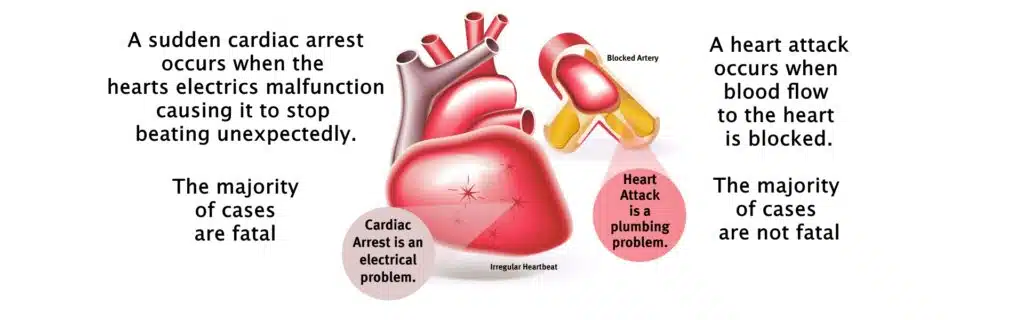
You will see the words “heart attack” all over the coverage. We do not yet know exactly what happened to Eriksen this time, but a heart attack is almost certainly the wrong description, just as it was in 2021. Here is why.
A heart attack is a plumbing problem. A blocked artery starves part of the heart muscle of blood. The person is usually awake and in pain.
A cardiac arrest is an electrical problem. The heart’s rhythm goes haywire, and it stops pumping. The person collapses, stops breathing normally, and loses consciousness within seconds. Without immediate CPR and a defibrillator, they will die. That is the part anyone can act on: in the first few minutes, starting CPR and using a defibrillator, is what decides whether someone lives.
We have tried to correct this confusion more times than we can count, including our long-running effort to get the NHS to fix its own wording. If you take one thing from this piece, let it be the difference between a cardiac arrest and a heart attack. The British Heart Foundation draws the same distinction.
What actually happened to Eriksen in 2021
At Euro 2020 (played in the summer of 2021), Eriksen suffered a cardiac arrest during Denmark’s match against Finland in Copenhagen. He collapsed. His heart stopped. He was given CPR on the pitch and shocked with a defibrillator, then stabilised before being taken to hospital.
He did not have a heart attack. And this is the second myth worth nailing: he was not fitted with a pacemaker. He was fitted with an ICD.
Christian Eriksen’s ICD: what it actually does
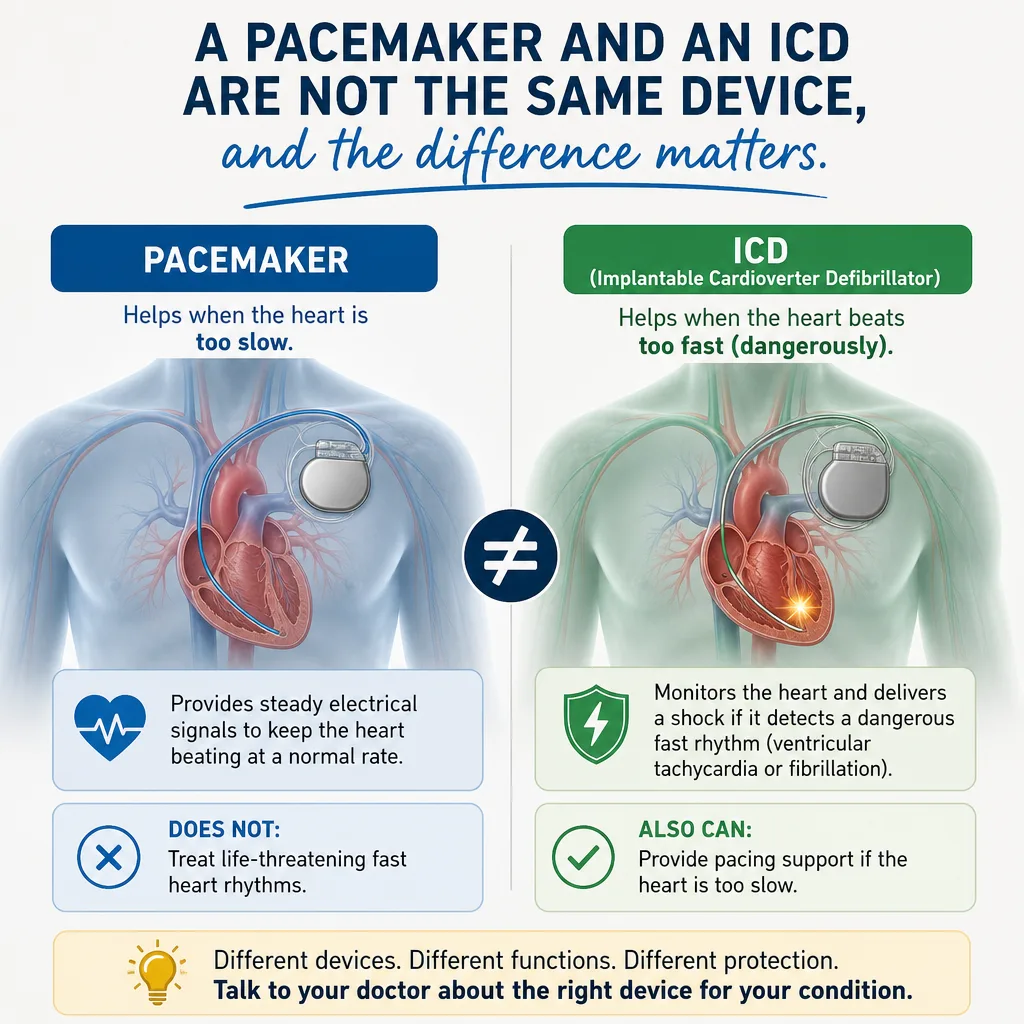
A pacemaker and an ICD are not the same device, and the difference matters.
A pacemaker is mostly used to treat a heart that beats too slowly. It nudges the rhythm along with tiny, painless electrical signals.
An ICD does that too, but it has a far more important job. It is a small guardian sitting inside the chest, watching every heartbeat. If it detects a dangerous, life-threatening rhythm, the kind that causes a cardiac arrest, it delivers a shock to reset the heart. In effect, every ICD recipient carries their own personal defibrillator, 24 hours a day. Most of us in the survivor community have a few choice words for the jolt it delivers, but it is the jolt that keeps us here. The British Heart Foundation has a clear explainer on how an ICD works, including the point that a standard ICD can also act as a pacemaker.
There is a great deal of misinformation about these devices, even among clinicians, which is why we wrote a whole piece dispelling the common myths about ICDs.
Did his ICD prevent the collapse from worsening?
Denmark’s team doctor, Morten Boesen, has said the device did what it was put there to do, while making clear that the cause of the collapse is still being investigated at Odense University Hospital. So the honest answer is this: the device appears to have worked, but the full picture isn’t in yet.
What we can say is that this aligns with what everyone can see. A cardiac arrest in someone without an ICD usually means a prolonged collapse, CPR from those nearby, and a shock from an external defibrillator. Eriksen, by contrast, was briefly unconscious, then up and walking within minutes. If Christian Eriksen’s ICD detected a dangerous heart rhythm and shocked it back to normal, that is precisely the kind of rapid save these devices are built for: alarming to watch, but far less dire than a cardiac arrest in someone without one.
There is an important nuance here, though. Not every ICD shock is a life-saving one. Sometimes these devices fire when they do not strictly need to, reading a fast but survivable rhythm, or even electrical interference, as something deadly. That is known as an inappropriate shock, and checking for it is one of the first things doctors do when they read the data off the device. Whether Eriksen’s shock was truly necessary or one of these false alarms is exactly what the hospital tests will establish. We explain the different kinds of ICD shock and what they mean on our dedicated page, and we will update this piece once the doctors know more.
Why this matters beyond football
It is easy to watch all this as a sports drama. For the tens of thousands of people in the UK living with an ICD, and for cardiac arrest survivors and their families, it is something far more personal.
It is a reminder that survival is possible. Eriksen is not the only person to collapse on a pitch and come back; ordinary players do it too. It is also a reminder that life with an ICD is a life that carries on, including, with care and the right advice, a return to the sports people love.
Mostly, though, it is a reminder to get the words right. Calling a cardiac arrest a “heart attack” or an ICD a “pacemaker” is not pedantry. It shapes what the public understands, how bystanders react, and ultimately who survives.
Our thoughts are with Christian Eriksen and his family.
Update from Christian on June 8th 2026
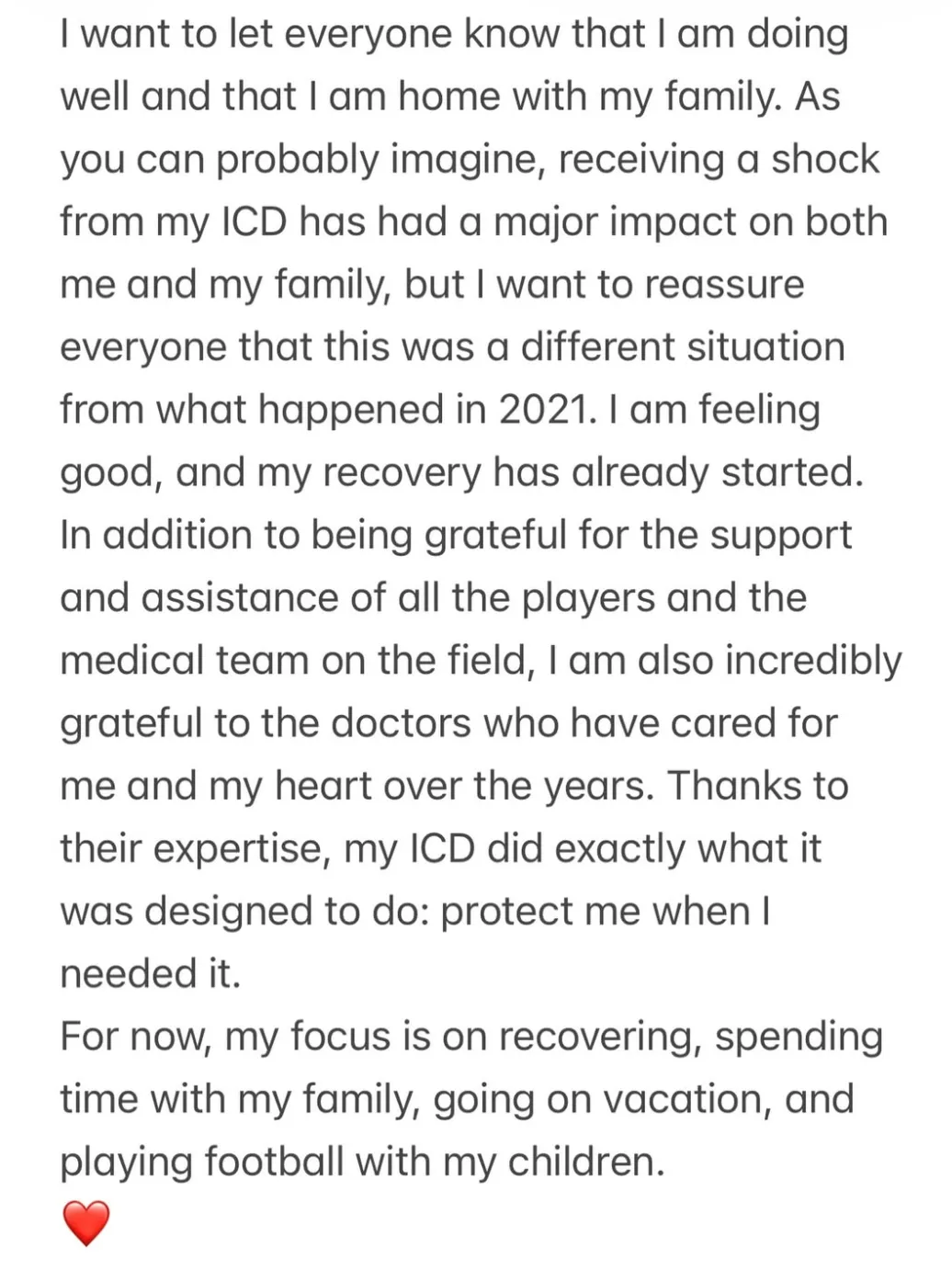
Late on 8 June, Christian Eriksen spoke publicly for the first time since the collapse, posting a message to fans on Instagram. It confirms what his team doctor had indicated: his ICD delivered a shock and did its job. He was also clear that this was a different situation from 2021. His message is below, in full.

After our first meet-up in February 2015, I realised I was not alone. It was the first time since my cardiac arrest the previous year that I had spoken face-to-face with someone who had experienced what I had. This was also true for my wife, who also happened to be my lifesaver. From that meet-up, the idea of SCA UK was born. Since then, we have achieved a considerable amount, primarily providing information, resources and support to others in a similar situation but also raising the profile of survivorship and the need for better post-discharge care. We are starting to get traction in this, and with the formation of the charity, I genuinely believe we have a bright future ahead and will make a significant difference in the lives of many who join our ranks.
Excellent and accurate piece, Paul. Says everything in the right context, as well. As you may remember my experience 35 years ago, I am fully affected except for the sports issue. One of my major pet peeves is the misunderstanding by professional medical personnel. There’s no excuse for that at all. Also, I have undergone 2 inappropriate shocks from which I sat up, wondering what the hell happened and found out from my implant centre within a day or so. What else…..both inappropriates occurred while I was still banned from driving, fortunately. That was in 1995. Since then, my correct diagnoses and adjusted drug therapies have kept me on the straight and narrow. My team at Harefield keep a very close watch on me via my bedside monitor and my odd phone call now and then.
thank you from Petaluma
Great article.
I had a SCA in 2019 during the London to Brighton cycle ride. I was VERY FIT AND HEALTHY and there’s NO family history of heart issues.
Sadly I woke up 3 days later and had to have a 3x bypass and a ICD fitted.
With gentle exercise and Intermittent Fasting (18:6) daily, my last Heart ❤️ scan showed my Surgeon informed me…” If I didn’t know your history & was just looking at the scan, I wouldn’t think you’d been through what you have.. your heart is normal, better than someone your age… Carry on doing whatever it is, I’m going to discharge you….”