
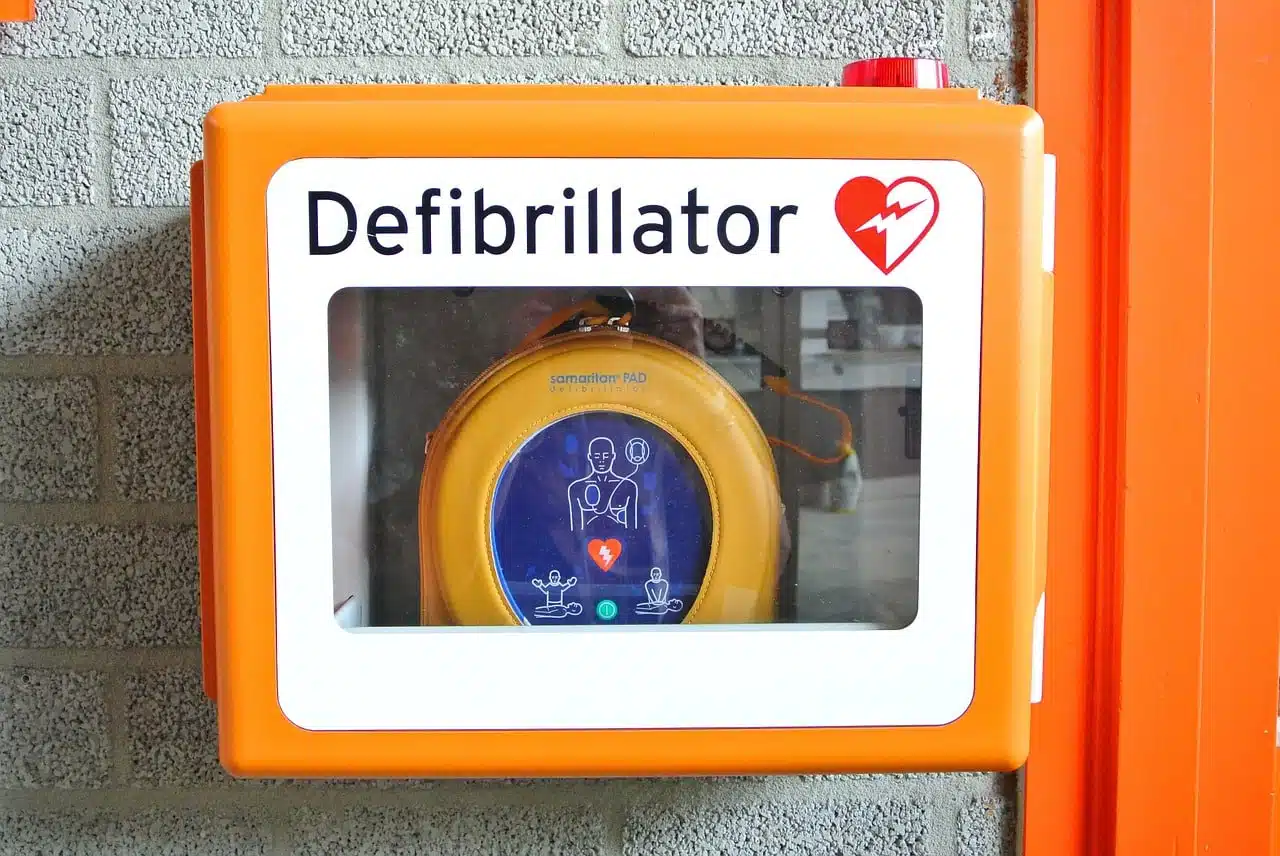
Defibrillators and cardiac arrest are inseparable: a defibrillator is the only device capable of stopping the dangerous heart rhythms that cause most cardiac arrests, and prompt defibrillation is one of the most important factors in whether a person survives. This page explains what defibrillators are, how they work, the different types in use, and where to find one.
What Is Defibrillation?
Defibrillation is the delivery of a controlled electric shock to the heart to stop a dangerous arrhythmia and give the heart the chance to restart in a normal rhythm. It works by briefly depolarising all of the heart’s muscle cells simultaneously — essentially pressing a reset button on the heart’s electrical system.
The two rhythms most commonly responsible for cardiac arrest — and the ones that defibrillators are designed to treat — are:
- Ventricular Fibrillation (VF) — the heart’s lower chambers quiver chaotically rather than pumping. This is the most common initial rhythm in sudden cardiac arrest and the one most responsive to early defibrillation.
- Pulseless Ventricular Tachycardia (pVT) — the heart beats extremely fast but produces no effective pulse. Also shockable.
There are also two cardiac arrest rhythms that cannot be defibrillated and require other treatments:
- Pulseless Electrical Activity (PEA) — electrical activity is present but the heart is not pumping effectively.
- Asystole — no electrical activity at all (flat line).
This is why an AED analyses the heart’s rhythm before delivering a shock — it will only shock when a shockable rhythm is detected. You cannot accidentally shock someone who does not need it. As the late Professor Douglas Chamberlain, one of the pioneers of community defibrillation in the UK, famously remarked: “the only damage you can do with an AED is if you whack someone round the head with one.”
Types of Defibrillator
There are two main types of defibrillator relevant to cardiac arrest survivors and the general public.
Automated External Defibrillator (AED)
An AED is an external defibrillator designed for use by members of the public with no medical training. It analyses the heart rhythm automatically, decides whether a shock is needed, and delivers it — talking the user through every step via audio instructions. AEDs are found in sports centres, shopping centres, train stations, airports, schools, offices, and many other public locations. When placed for public access they are known as Community Public Access Defibrillators (CPADs).
Early defibrillators required the operator to interpret the rhythm and decide when to shock. As technology advanced, analysis and decision-making were automated, making the devices progressively easier and safer for untrained bystanders to use. The Resuscitation Council UK recommends that CPADs should be freely accessible at all times — though many are housed in a locked cabinet with a code available by calling 999.
Implantable Cardioverter Defibrillator (ICD)
An ICD is a small device implanted under the skin — usually near the collarbone — that continuously monitors the heart and delivers a shock automatically if a dangerous rhythm is detected. It is the most common long-term treatment for cardiac arrest survivors and for people at high risk of a first arrest due to an underlying heart condition.
For full information on ICDs, how they are implanted, what a shock feels like, and how to live with one, see our dedicated ICD section.
Using a Defibrillator in a Cardiac Arrest Emergency
AEDs are designed to be used by anyone. If you encounter someone in cardiac arrest:
- Call 999 immediately — or shout for someone else to call while you start CPR.
- Start CPR — push hard and fast in the centre of the chest. Do not wait for the AED before starting compressions.
- Get the AED — send someone to fetch it, or retrieve it yourself if no-one else is available. The 999 operator can tell you the location of the nearest registered device.
- Switch it on and follow the instructions — the AED will guide you through pad placement, analysis, and if needed, the shock. Continue CPR whenever the AED instructs.
Every minute without CPR and defibrillation reduces the chance of survival. This is why the chain of survival places early CPR and early defibrillation as its central links. The video below demonstrates AED use clearly.
Finding a Defibrillator Near You
The best way to find your nearest AED is DefibFinder — the public-facing locator tool powered by The Circuit, the UK’s national defibrillator network. The Circuit is run in partnership with the British Heart Foundation, NHS England, and all UK ambulance trusts, and its data is what the 999 service uses to direct callers to their nearest registered device.
If you manage or own a defibrillator that is not yet registered, please register it at thecircuit.uk. An unregistered AED is invisible to the 999 service. We have a full list of national and regional AED maps on our Defib Maps page.
Organisations That Place Defibrillators in Communities
A number of charities and organisations work to fund and place defibrillators in public spaces across the UK. These include:
- SADS UK — Sudden Arrhythmic Death Syndrome UK, supporting families affected by conditions that can cause sudden cardiac death, including AED placement work.
- The Oliver King Foundation — founded following the death of 12-year-old Oliver King from cardiac arrest, focused on placing defibrillators in schools.
- Community Heartbeat Trust — a leading charity supporting rural and community AED placement, and the organisation behind the Adopt a Phone Box scheme.
- British Heart Foundation — funds defibrillator placement nationally and runs The Circuit in partnership with NHS England and the ambulance services.
Learn More and Get Trained
Knowing how to use an AED is straightforward — but practising beforehand builds confidence that matters in a real emergency. CPR and AED training is widely available across the UK, often free of charge. The chain of survival depends on bystanders who are willing and able to act.
See also: Implantable Cardioverter Defibrillator (ICD), AED and Defibrillator Maps, The Chain of Survival, CPR Training, and Douglas Chamberlain.