
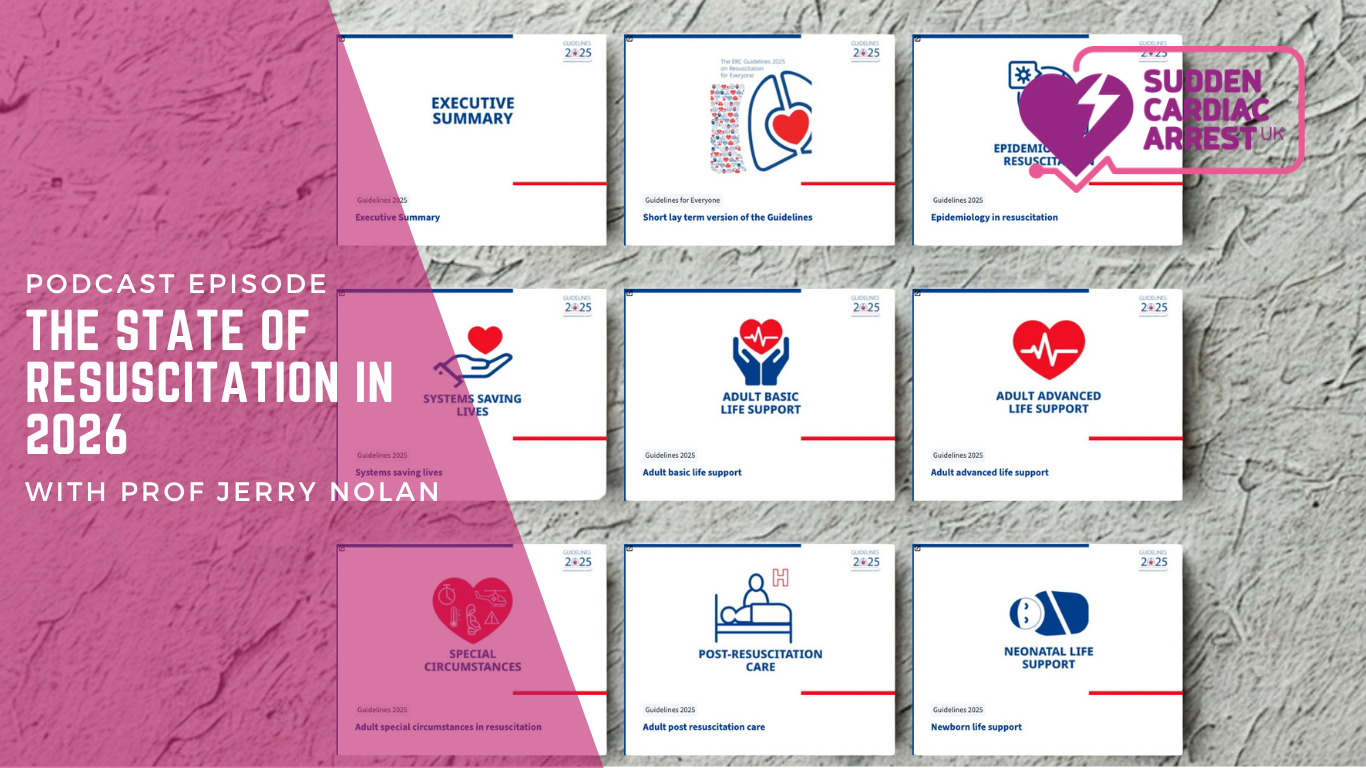
Six years after our first conversation, Professor Jerry Nolan — editor in chief of the journal Resuscitation and a leading figure in the field — returns to the podcast. Back then, he was chairing the European Resuscitation Council and preparing for the 2020 guidelines. A lot has changed since.
Listen to the episode
What we cover
This is a wide-ranging, honest conversation spanning the full landscape of resuscitation science and survivorship.
Survival rates have plateaued at around 9–10% in the UK — Jerry explains why changing patient demographics are masking real progress in care.
COVID-19 increased cardiac arrest incidence and reduced survival both in and out of hospital. Jerry also offers a measured take on vaccination.
The 2025 ERC guidelines involved a massive international collaboration and, for the first time, formally included patient and co-survivor voices. Jerry walks us through the scale of the effort — from ILCOR evidence reviews to public consultation.
The Chain of Survival has been redesigned with a new ring dedicated to recovery and quality of life, encompassing survivors and the community around them.
Temperature control has shifted dramatically — routine cooling has largely stopped, but exciting intra-arrest cooling trials could change the picture again. Jerry reassures those who were cooled: there’s no evidence of harm.
Prognostication now works both ways — predicting good outcomes, not just poor ones — which helps families and guides treatment decisions during the most uncertain hours.
Rehabilitation remains the biggest gap. Cardiac arrest survivors fall between cardiac rehab and brain injury services, and the evidence base for interventions is still frustratingly thin.
Co-survivors — family members, bystanders, lay rescuers — are now formally recognised in the guidelines. We discuss the language shift from “bystander” to “co-survivor” and the emerging research from the Essex-based RESCUE project.
Technology and AI are reshaping the field: from smartwatches detecting cardiac arrest, to AI interpreting brainwaves, to large language models accelerating guideline development.
About Professor Jerry Nolan
Professor Nolan is the editor-in-chief of Resuscitation, a board member of the ERC, and a consultant anaesthetist. He has shaped international resuscitation guidelines for over two decades.
Resources
- ERC 2025 Guidelines — free to download
- Resuscitation Council UK
- ILCOR — open for public comment
If this episode resonated with you, please share it with someone who might benefit.

Po naszym pierwszym spotkaniu w lutym 2015 roku zdałem sobie sprawę, że nie jestem sam. Po raz pierwszy od czasu mojego zatrzymania akcji serca w poprzednim roku rozmawiałem twarzą w twarz z kimś, kto przeżył to samo co ja. Dotyczyło to również mojej żony, która, jak się okazało, uratowała mi życie. Właśnie podczas tego spotkania narodził się pomysł stworzenia organizacji SCA UK. Od tamtej pory osiągnęliśmy naprawdę wiele – przede wszystkim dostarczamy informacje, zasoby i wsparcie innym osobom w podobnej sytuacji, ale także zwracamy uwagę na losy osób, które przeżyły zatrzymanie krążenia, oraz na potrzebę lepszej opieki po wypisaniu ze szpitala. Zaczynamy osiągać postępy w tej dziedzinie, a wraz z utworzeniem organizacji charytatywnej szczerze wierzę, że czeka nas świetlana przyszłość i że znacząco zmienimy życie wielu osób, które dołączą do naszych szeregów.
Just listened the podcast with Paul Swindell in discussion with Professor Jerry Nolan. . An honest discussion. Paul, you asked probing and difficult questions in your usual measured way. But also with the underlying knowledge and experience as a cardiac arrest survivor. Professor Nolan answered acknowledging that progress in supporting survivors and co-survivors takes time, but a start has been made. Thank you both. Jeanne Reilly Cardiac Arrest survivor